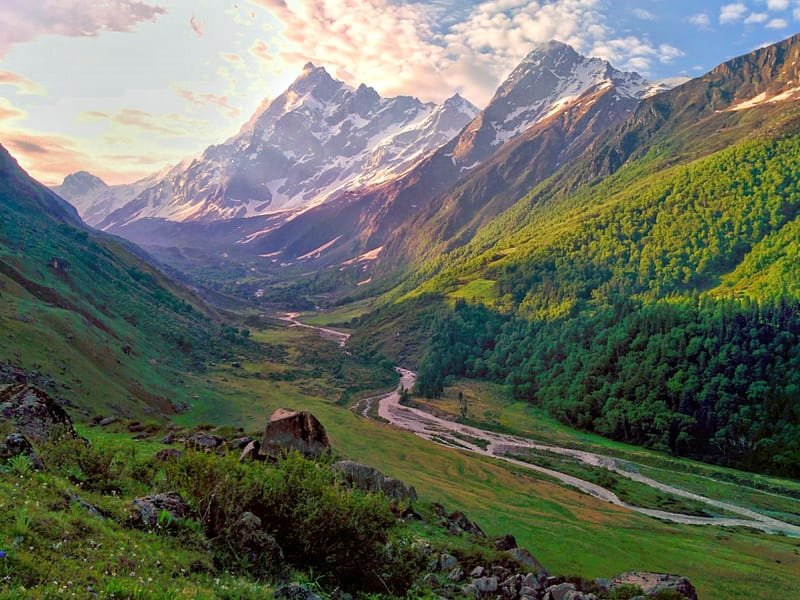
A UNESCO World Heritage site that only opens for the monsoon, when around 300 species of alpine flower bloom at once. Paired with Hemkund Sahib at 4,632 m.
Valley of Flowers & Hemkund Sahib at a glance
Duration
6 days / 5 nights
Maximum altitude
4,632 m
Difficulty
Moderate
Best season
Jul - Sep
Departures
Every Sunday
Starts from
Haridwar
Group size
Max 15
Overview
The Valley of Flowers is a national park in the Bhyundar valley that spends most of the year under snow and comes alive for roughly ten weeks of monsoon. Around 300 species flower there, many of them found nowhere else at that density. The base is Ghangaria, reached on a 9 km walk from Govindghat, and from there the valley is a day walk and Hemkund Sahib - a glacial lake and gurudwara at 4,632 m - is a steeper one.
Highlights
UNESCO World Heritage national park
Peak bloom from mid July to late August
Hemkund Sahib at 4,632 m
Monsoon walking through the Bhyundar valley
Day by day itinerary
Day 1
Haridwar to Joshimath
Drive up the Alaknanda valley through Devprayag, Rudraprayag and Karnaprayag.
Day 2
Joshimath to Ghangaria
Drive to Govindghat, then walk 9 km to Ghangaria (3,050 m).
Day 3
Valley of Flowers
Day walk into the valley, several hours among the bloom, returning to Ghangaria by evening.
Day 4
Hemkund Sahib
A 6 km climb to the glacial lake and gurudwara at 4,632 m, then back down to Ghangaria.
Day 5
Ghangaria to Joshimath
Walk down to Govindghat and drive to Joshimath.
Day 6
Return to Haridwar
Long drive down the valley, arriving Haridwar by evening.
What is included
Return transport from Haridwar
Accommodation on twin sharing
Breakfast and dinner daily
Guide throughout
National park entry permits
First-aid kit, oxygen and oximeter
What is not included
Lunches and personal expenses
Pony or porter charges
Travel insurance
Costs from weather delays or road closures
Anything not listed under inclusions
Questions about this package
Mid July to late August is peak bloom. The park opens on 1 June and closes on 4 October, but early June and late September have far fewer flowers.
It is 9 km with a steady climb from Govindghat, usually five to six hours. Ponies and porters are available at the trailhead if you would rather not carry a pack.
No. It is an optional day and a hard one - 6 km of steep climbing to 4,632 m. Plenty of people spend that day back in the valley instead, and that is a perfectly good choice.
A hanging valley in the Govind National Park, reached through the old wooden villages of Osla and Seema, with the Swargarohini massif standing at its head.
The highest Shiva temple in the world, and a sunrise summit at 4,000 m that puts Nanda Devi, Trishul and Chaukhamba on the same horizon. The easiest big view in Garhwal.
The winter trek most people start with: pine forest under deep snow, a camp at Juda ka Talab, and a summit at 3,810 m that gives you the whole Garhwal range at sunrise.

 Trek